
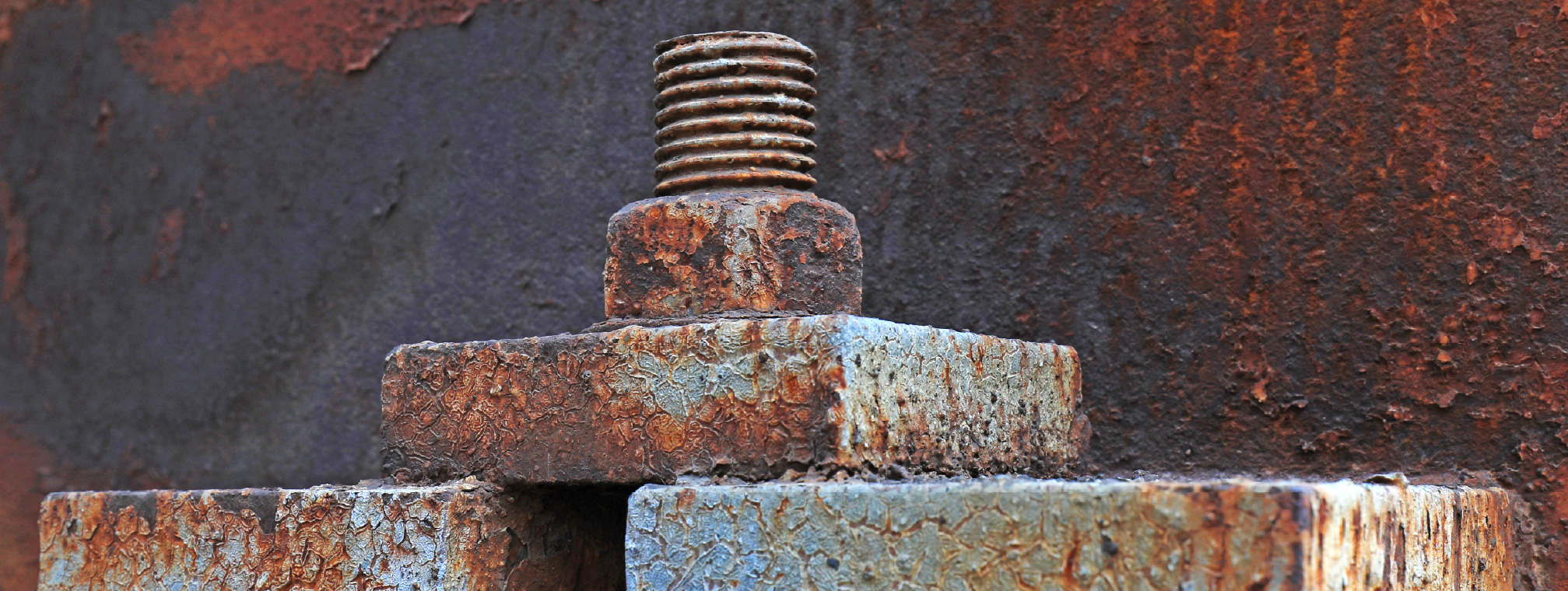
Corrosion continues to incur staggering costs across a wide range of industries, resulting in production stoppages, equipment failures, and compromised personnel safety. For maintenance teams, engineers, and procurement professionals, preventing corrosion-related fastener issues is an ongoing priority.
In this blog, the fastener experts from All-Pro explain the common types of corrosion, how to recognize them, and outline steps to minimize risk through material and finish selection.
6 Common Types of Fastener Corrosion
The first step in mitigating corrosion-related fastener damage is identifying the type of corrosion. Corrosion has several causes; below are some of the most common that affect fasteners.
1. General or Uniform Corrosion
Uniform corrosion, also known as general corrosion, is the most common type of corrosion affecting fasteners. It develops uniformly across an exposed surface and progressively thins the material until failure occurs.
Uniform corrosion is predictable; it’s usually a result of materials being continuously exposed to the environment. This type of corrosion can be minimized by choosing fastener materials and coatings that are well-suited for the application environment.
2. Galvanic Corrosion
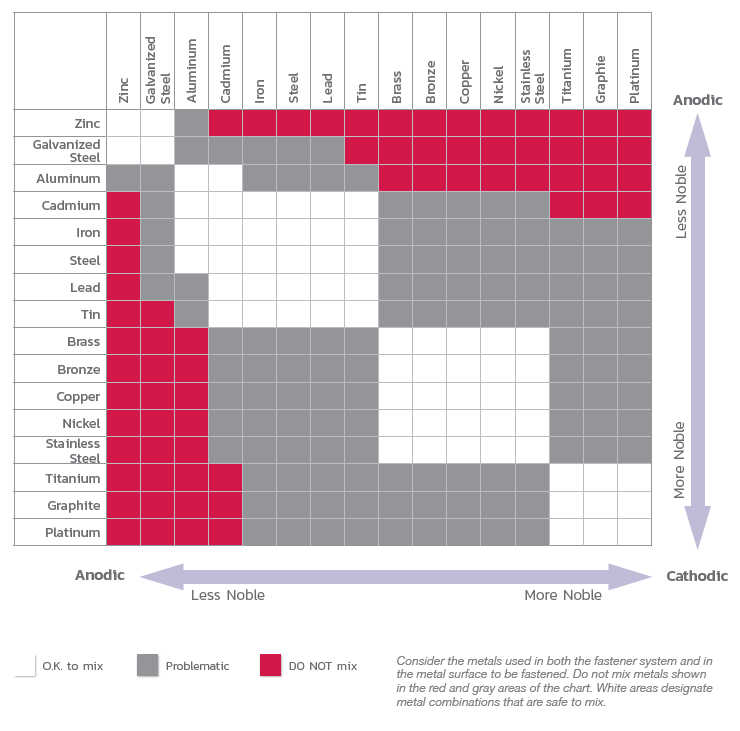
Galvanic corrosion can occur when two dissimilar metals are in contact. If the fastener material and the mating surface material are not compatible, corrosion can accelerate quickly.
If you’re seeing unexpected corrosion at the joint, reviewing material pairings should be your first move. Refer to the table below to learn more about which materials shouldn’t be used together:
3. Pitting Corrosion
Also known as pitting, this type of corrosion is typically caused by damage to the fastener’s coating, resulting in extremely localized corrosion damage. Over time, this corrosion can spread and lead to failure.
Pitting can often be reduced by selecting more resilient fasteners and finishes that are less prone to mechanical damage during handling, installation, and service.
4. Fretting Fatigue and Corrosion
Fretting fatigue occurs when two metals are in contact under load and experience vibration. The motion wears the metal surfaces over time, and it tends to accelerate because the metallic debris created by fretting acts like sandpaper on the remaining material.
To mitigate fretting fatigue, lubrication and proper material selection are key. In some cases, pairing steel with materials such as lead or silver plate can dramatically increase resistance.
5. Stress Corrosion and Fatigue
Stress corrosion and fatigue occur when a metal is simultaneously subjected to corrosion and static tensile stress, leading to cracking. This type can be difficult to detect, but it can be minimized with proper surface treatments and by avoiding designs that can produce corrosion initiation sites.
6. Erosion Corrosion
Erosion corrosion is caused by fluid moving over a metal surface, such as in pipelines, valves, cooling systems, and propellers. Over time, the fluid will wear down the metal, especially if it contains abrasives.
Erosion can often be countered by selecting harder metals that better tolerate the abrasive action of the flow.
Mitigating Fastener Corrosion
The most effective method to mitigate fastener corrosion is to select the right material for your application. Improper material choice can accelerate corrosion, like galvanic corrosion, or contribute to more gradual corrosion over time.
In many cases, choosing an appropriate coating or plating is a highly effective approach. It’s often less costly than switching base materials and can deliver meaningful corrosion protection when matched to the application
Common Corrosion-Resistant Coatings and Platings
Below are several commonly used options, each suited for particular environments and applications:
- Zinc – low-cost and very common in industrial applications
- Phosphate – provides a good surface for other coatings to adhere to
- Nickel – commonly used as an undercoat to boost corrosion resistance
- Cadmium – provides superior corrosion protection in wet environments
- SermaGard® – commonly used in chemical and petrochemical processing
- Xylan® – fluoropolymer coating designed for water applications
This list is not comprehensive; numerous other coatings are available, including specialty options. The right coating option ultimately depends on your application and the desired level of corrosion resistance.
Refining Your Fastener Search with All-Pro
If you’re not sure which fastener materials or coatings are best for your environment, our fastener experts can help you quickly narrow the field and avoid costly missteps.
Connect with an All-Pro expert by calling 800-361-6627, emailing [email protected], or filling out our contact form: