
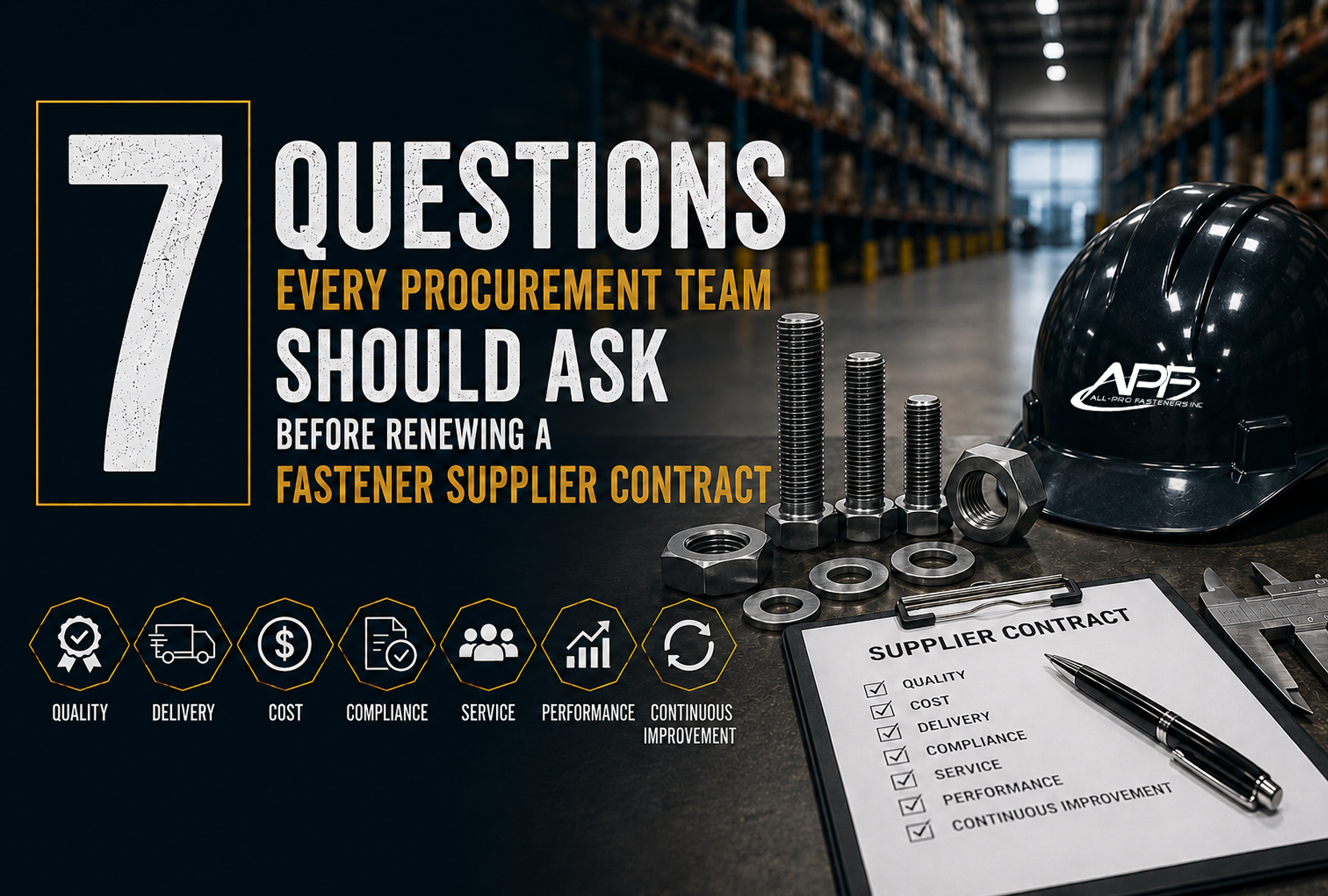
Renewing a supplier agreement is often viewed as an administrative task. If deliveries have been arriving on time and invoices have been paid, it’s easy to simply extend the contract and move on.
But today’s procurement environment is more demanding than ever. Supply chain disruptions, changing quality requirements, evolving customer expectations, and increasing pressure to reduce total cost mean supplier performance deserves regular evaluation.
Before renewing your next fastener supply agreement, take the opportunity to ask a few important questions. The answers can help determine whether your supplier is positioned to support your business, both today and throughout the life of your next contract.
1. Can You Meet Our Future Manufacturing Requirements?
Your fastener needs today may look very different a year from now. Product changes, new customer requirements, or market expansion may require custom parts, different materials, or tighter standards.
Ask your supplier:
- Can you manufacture custom or print-to-spec components?
- What in-house manufacturing capabilities do you have?
- Can you support product modifications without lengthy lead times?
Working with a supplier that offers both manufacturing and distribution capabilities can reduce complexity while providing greater flexibility as your requirements evolve. The ability to source standard products and custom components from a single supplier simplifies procurement and reduces supplier management effort.
2. What Happens If the Supply Chain Is Disrupted?
Recent years have demonstrated how quickly supply chains can change. Material shortages, transportation delays, geopolitical events, and natural disasters can all affect product availability.
Important questions include:
- How do you manage inventory risk?
- Do you maintain safety stock?
- What contingency plans exist for supply interruptions?
- Can you source from multiple qualified manufacturers?
A resilient supplier should be able to explain how they maintain continuity during unexpected events rather than simply reacting when problems arise. Strong supply chain partners invest in planning, supplier diversification, and inventory strategies to help customers avoid production interruptions and maintain reliable delivery performance.
If you’re considering a change in your supply chain, consider reading our blogs covering what you need to know:
- When to Choose Domestic Manufacturing for Critical Fasteners
- Strengthening Your Fastener Supply Chain: Why Single Sourcing is a Strategic Move
3. What Supply Chain Services Do You Offer?
Price is only one component of procurement cost. Administrative expenses, inventory carrying costs, receiving labor, stockouts, and production downtime often have a much greater impact on total cost than unit price alone.
Ask whether your supplier offers services such as:
- Vendor Managed Inventory (VMI)
- Stock-and-release programs
- Custom labeling or barcoding
- Kitting and binning programs
These services can improve inventory use, reduce workloads for procurement teams, and streamline operations throughout your organization. For more information, read our blog covering supply chain services and how they can generate long-term savings.
As supply chains become more integrated, many procurement teams are looking beyond product suppliers toward partners that can help simplify daily operations.
4. How Do You Ensure Product Quality?
Quality should never be assumed. Ask your supplier to explain their quality management process, including:
- Incoming material inspections
- Lot traceability
- Document control
- Inspection procedures
- Corrective action processes
A supplier should be able to clearly explain how products move while maintaining consistency throughout the process. Organizations with established quality management systems and documented procedures often provide greater confidence, particularly for critical or safety-related applications.
Learn the essentials of fastener quality and documentation by reading our blog: “The Procurement Professional’s Guide to Fastener Quality and Documentation”.
5. What Testing Capabilities Do You Have?
Many suppliers rely entirely on third-party testing. While outside laboratories have their place, in-house testing capabilities can often improve responsiveness and shorten lead times when verification is required.
Questions to ask include:
- Do you have in-house testing capabilities?
- What tests can you perform?
- Can you provide testing documentation?
- How quickly can testing be completed?
Depending on the application, testing may include tensile testing, hardness verification, dimensional inspection, plating thickness measurement, rotational capacity testing, positive material identification, or other quality verification methods.
Having access to comprehensive testing capabilities helps ensure products meet specifications before reaching your facility.
6. Can You Help Improve Our Procurement Process?
Fulfilling orders is the bare minimum. The best suppliers actively look for ways to improve your purchasing process.
Ask your supplier:
- Can you identify opportunities to consolidate part numbers?
- Can you help standardize specifications?
- Are there opportunities to reduce inventory?
- Can you recommend alternate products that improve availability or reduce cost?
Experienced suppliers work with customers across multiple industries and applications, allowing them to identify process improvements that individual organizations may overlook. These collaborative conversations can lead to measurable savings without sacrificing product performance.
Need a quick guide to help improve your RFQ results? Learn what to include in our practical RFQ guide for procurement personnel.
7. Are You Prepared to Support Our Business Long-Term?
Finally, consider whether your supplier is positioned to grow alongside your organization.
Questions worth asking include:
- How have your capabilities expanded in recent years?
- What investments have you made in manufacturing, quality, or technology?
- How do you support long-term customer relationships?
- Who will be responsible for managing our account?
The answers often reveal whether you’re working with a transactional vendor or a strategic supply partner. Long-term procurement success depends on consistent communication, technical expertise, dependable service, and the ability to adapt as your business changes.
A supplier that continually invests in manufacturing capabilities, quality systems, inventory management, and customer support is better positioned to provide lasting value throughout the life of your contract.
Renewing a Contract Is an Opportunity
Contract renewals shouldn’t simply focus on negotiating price. They’re an opportunity to evaluate your supplier and whether they meet your organization’s needs.
At All-Pro Fasteners, we’ve found that the strongest supplier relationships are built on transparency, continuous improvement, and a shared commitment to helping customers achieve reliable supply, consistent quality, and efficient operations. Whether supporting standard fasteners, custom manufacturing, quality assurance, or value-added supply chain services, the goal remains the same: helping procurement teams source with greater confidence today while preparing for tomorrow’s challenges.
Contact an All-Pro expert today to see how our integrated fastener supply approach can work for you by calling 800-361-6627, emailing [email protected], or submitting a quote request.